

They are the most violent objects in the universe. A region where space itself collapses and nothing — not even light — escapes. But could one actually reach us?
Technically yes — a black hole could destroy Earth. But the probability of one ever reaching us is so astronomically small that scientists say it has almost certainly never happened in Earth’s 4.5-billion-year history, and likely never will.
Black holes occupy a unique place in the human imagination. They are simultaneously real, confirmed by science, photographed directly for the first time in 2019, and deeply alien — objects so extreme that our intuitive understanding of space, time, and matter simply breaks down inside them. It is no surprise that one of the most common questions in all of space science is this: could a black hole destroy the Earth?
The answer requires us to understand what black holes actually are, how they behave, and what would need to happen for one to reach our planet. The truth is stranger, more violent, and ultimately more reassuring than most science fiction suggests.
What Exactly Is a Black Hole?
A black hole is a region of spacetime where gravity has become so intense that the escape velocity exceeds the speed of light. Since nothing in the universe can travel faster than light, nothing that crosses a black hole’s event horizon — its point of no return — can ever escape. Not matter. Not light. Not information.
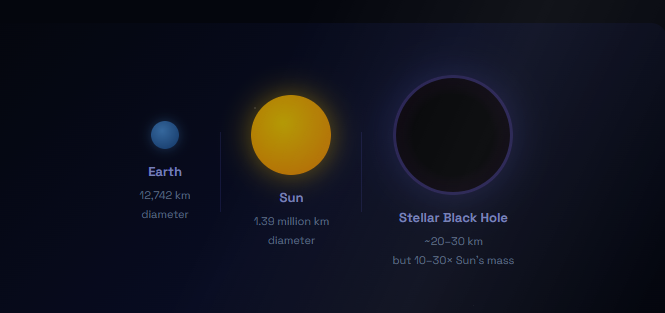
Most stellar black holes form when a massive star, typically more than twenty times the mass of our Sun, exhausts its nuclear fuel. Without the outward pressure of fusion to counteract gravity, the star’s core collapses with catastrophic force in a fraction of a second, triggering a supernova explosion. What remains is an object of extraordinary density — a mass greater than the Sun compressed into a sphere perhaps twenty kilometres across.
There are also supermassive black holes, residing at the centres of most large galaxies — including our own Milky Way, where Sagittarius A* lurks with the mass of four million Suns. And more speculatively, primordial black holes are theorised to have formed in the chaos of the early universe and might, in principle, be microscopic.
How Would a Black Hole Actually Destroy Earth?
There is a common misconception that black holes act like cosmic vacuum cleaners, actively sucking in everything around them. They do not. A black hole’s gravity obeys exactly the same laws as any other object’s gravity. If you swapped the Sun for a black hole of identical mass, Earth would continue orbiting in exactly the same path — just in permanent darkness.
The only way a black hole destroys a planet is through direct, close encounter. And if that encounter happened, the process would be spectacular.
Stage 1: Tidal Disruption
As Earth approached a stellar-mass black hole, the difference in gravitational pull between the near side of Earth and the far side would grow enormous. This differential force — called a tidal force — would begin to stretch our planet along the direction of approach while compressing it sideways. Oceans would tear free first, atmosphere would be stripped, and the solid crust would fracture and separate.
Stage 2: Spaghettification
This is one of astrophysics’ more evocative technical terms, and it is perfectly accurate. As Earth crossed the tidal disruption radius, the planet would be stretched into a long, thin stream of debris — like cosmic pasta — spiralling into the black hole’s accretion disc. The heating from compression and friction would cause this debris stream to radiate enormous energy before being consumed.Normal Earth→Tidal stretch→Elongating→SpaghettificationSpaghettification: tidal forces stretch and compress any object approaching a black hole’s event horizon into a thin stream of matter.
“In short order, the gravitational and atomic bonds holding Earth together can be shattered, transforming our planet from a solid sphere into a thin, stretched debris stream.”— Big Think / Ethan Siegel, Astrophysicist
How Far Away Are Black Holes From Earth?
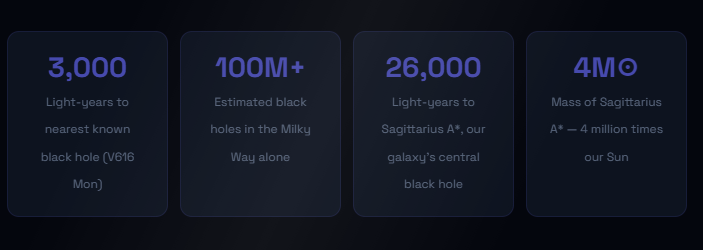
This is where the story becomes reassuring. The universe contains an estimated ten billion to one trillion black holes — but space is almost incomprehensibly vast.Earth0 lySun8.3 light-minutesV616 MonNearest known black hole ~3,000 lySgr A*Galactic centre ~26,000 lyAll known black holes are many thousands of light-years away — distances so vast light takes thousands of years to cross them.The nearest known black hole candidate, V616 Monocerotis, is approximately 3,000 light-years from Earth. One light-year is about 9.46 trillion kilometres.
V616 Monocerotis, the nearest known black hole candidate, is around 3,000 light-years away — a distance so vast that even travelling at the speed of light, you would need three thousand years to reach it. And there is no known mechanism that would bring it toward us.
At the centre of our galaxy sits Sagittarius A*, a supermassive black hole with the mass of four million Suns. It is 26,000 light-years away, and in 2022 the Event Horizon Telescope captured its direct image for the first time. Despite its monstrous size, it poses no direct threat — we orbit it, along with the rest of the Milky Way’s stars, in a stable orbit that has persisted for billions of years.🔭NASA confirms: “The orbit of a black hole would have to be very close to the solar system to affect Earth, which is not likely. If a black hole with the same mass as the Sun were to replace the Sun, Earth would not fall in.”
Could a Rogue Black Hole Come Towards Us?
This is the scenario that makes for compelling science fiction: a black hole ejected from a distant system or galaxy, travelling through the interstellar void, heading for our solar system with no warning. It would be dark, nearly invisible, and detectable only by the gravitational distortions it causes on light and surrounding matter.
Could this happen? In principle, yes. Black holes can be kicked out of binary systems by supernova asymmetries, receiving a natal kick that sends them on new trajectories through the galaxy. But the Milky Way is roughly 100,000 light-years across, and even a fast-moving rogue black hole travels at hundreds of kilometres per second — a tiny fraction of the galaxy’s scale.
| Scenario | Description | Risk to Earth |
|---|---|---|
| Nearest known BH (V616 Mon) | 3,000 light-years away, no trajectory toward us | Essentially zero |
| Sagittarius A* (Milky Way centre) | 26,000 light-years, stable galactic orbit | Zero |
| Rogue stellar-mass black hole | Ejected BH travelling through galaxy | Astronomically low |
| Direct close encounter (hypothetical) | BH passes within solar system | Catastrophic if occurred |
| Primordial micro black holes | Theoretical; would pass through Earth harmlessly | Negligible |
Astronomers at the Museum of Science have done the maths: the probability of a black hole passing close enough to the solar system to cause harm — even once across the entire 13.8-billion-year age of the universe — is essentially zero. As Dr. Phil Plait summarises bluntly: “Can a black hole destroy the Earth? Yes. Will a black hole destroy the Earth? Probably not.”
What About Black Holes Made in Laboratories?
When CERN’s Large Hadron Collider came online, some worried that high-energy particle collisions could create micro black holes capable of devouring the Earth from the inside out. This concern was taken seriously enough that physicists published detailed safety assessments.
Their conclusion: even if the LHC created micro black holes — which remains entirely theoretical — such objects would be so short-lived that they would evaporate almost instantly through a process known as Hawking radiation. Smaller black holes evaporate faster, and any black hole formed in a particle collision would have a lifespan measured in fractions of a second, too brief to interact meaningfully with any surrounding matter. The LHC has been running for over fifteen years, and Earth remains intact.
What Astronomers Actually Say
The scientific consensus, drawn from institutions including NASA, the European Space Agency, and major research universities, is consistent: there are no known black holes on a trajectory that threatens the solar system, and the statistical probability of an encounter within any human-relevant or even geological timeframe is negligibly small.
The more pressing end-of-Earth scenarios in astronomy involve the Sun itself. In approximately five billion years, our Sun will expand into a red giant, engulfing Mercury, Venus, and possibly Earth. Life on Earth faces a more immediate challenge in roughly one to two billion years as the Sun gradually brightens and heats our planet beyond the conditions necessary for liquid water. Compared to these slow-burning certainties, a black hole encounter remains a rounding error in cosmic risk assessment.