

Introduction
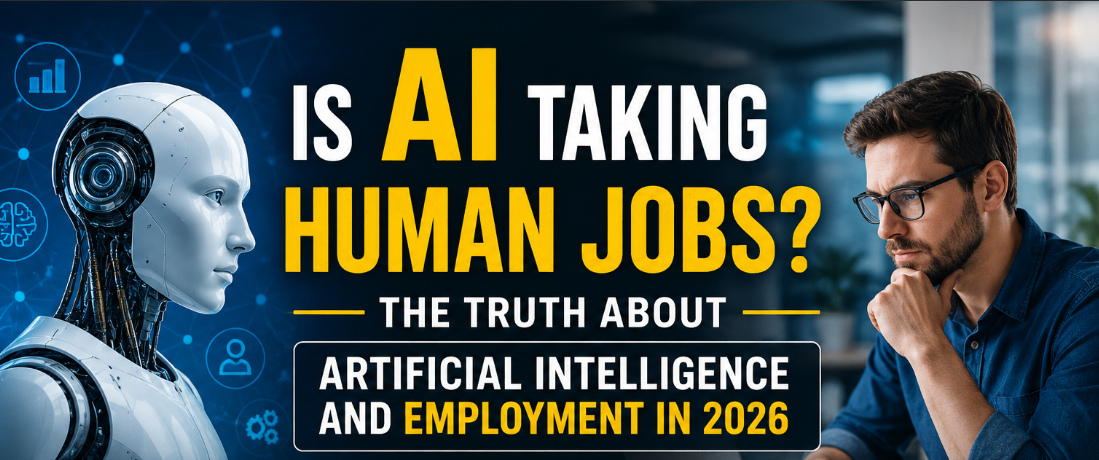
Artificial Intelligence (AI) is changing the way we work, communicate, and do business. From ChatGPT writing content to self-checkout machines in stores, AI is becoming a part of everyday life. This rapid growth has created an important question:
Is AI taking human jobs?
Many people fear that machines will replace workers, leading to mass unemployment. Others believe AI will create new opportunities and improve productivity. The reality lies somewhere in between.
How AI Is Replacing Certain Jobs
AI excels at handling repetitive, predictable tasks. As a result, some jobs are becoming automated.
Examples include:
- Data entry operators
- Basic customer support agents
- Telemarketing executives
- Routine bookkeeping roles
- Simple content generation
Many companies now use AI chatbots to answer customer questions, reducing the need for large support teams. Similarly, AI-powered software can process invoices, analyze documents, and generate reports much faster than humans.
Jobs That AI Cannot Easily Replace
Despite its impressive capabilities, AI lacks human creativity, empathy, and complex decision-making skills.
Jobs that remain relatively safe include:
- Teachers and educators
- Healthcare professionals
- Psychologists and counselors
- Skilled tradespeople
- Artists and creative professionals
- Business leaders and entrepreneurs
These professions require emotional intelligence, critical thinking, and human interaction—areas where AI still struggles.
AI Is Creating New Jobs Too
History shows that technological revolutions often create more jobs than they eliminate.
AI is generating demand for:
- AI Engineers
- Data Analysts
- Machine Learning Specialists
- Prompt Engineers
- AI Ethics Consultants
- Cybersecurity Experts
- AI Trainers
Businesses need people who can build, manage, monitor, and improve AI systems.
The Real Threat: Not AI, But Lack of Adaptation
The biggest risk is not AI itself.
The real danger is failing to learn new skills.
Workers who continuously update their knowledge will have a significant advantage. Learning data analysis, digital marketing, coding, AI tools, or business skills can make professionals more valuable in the AI era.
As the saying goes:
AI will not replace humans. Humans who use AI may replace humans who do not.
What Skills Should You Learn?
To stay competitive, focus on:
Technical Skills
- Data Analysis
- Excel and Power BI
- Python Programming
- SQL
- AI Tools and Automation
Human Skills
- Communication
- Leadership
- Problem Solving
- Creativity
- Emotional Intelligence
The combination of technical and human skills will be highly valuable in the future job market.
The Future of Work
Most experts believe the future will involve collaboration between humans and AI.
Doctors will use AI to detect diseases faster.
Lawyers will use AI to review documents.
Teachers will use AI to personalize learning.
Content creators will use AI to research and edit faster.
Rather than replacing people entirely, AI is more likely to become a powerful assistant.
Conclusion
So, is AI taking human jobs?
The answer is yes—and no.
AI is replacing some repetitive and routine tasks. However, it is also creating new careers, increasing productivity, and transforming industries.
The winners in the AI age will not be those who fear technology but those who learn how to work alongside it.
The future belongs to people who combine human creativity, judgment, and empathy with the power of artificial intelligence.
AI is changing jobs, not eliminating the need for humans.